

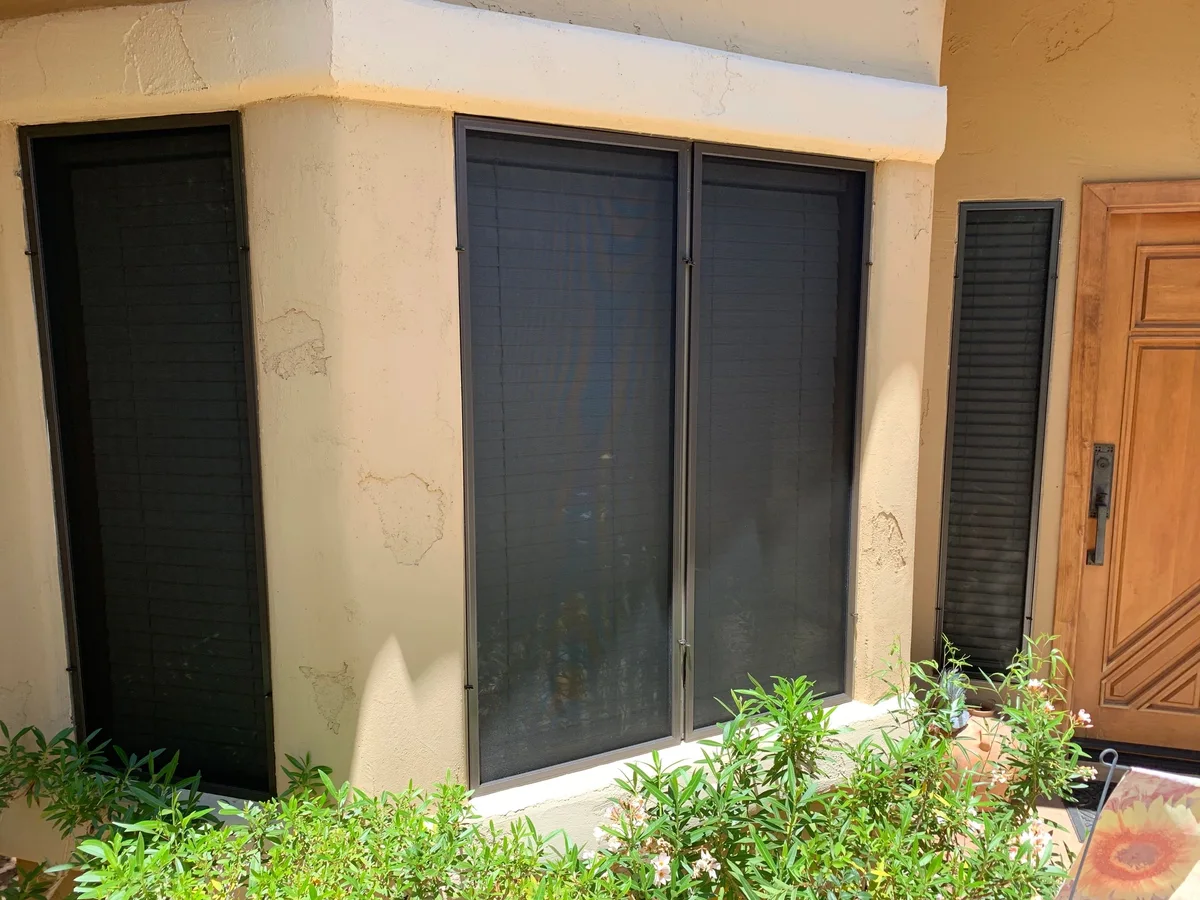
Start with the open-window routine
Describe which windows or doors you use, when they are opened and which insects are the concern. Actual use is more helpful than applying one summer fabric to every opening.
The screen addresses its own opening. Other property entry routes or a wider pest concern can require separate advice rather than a guarantee from one panel.
Outdoor temperature and air conditions matter when opening a window. A mesh layer does not automatically make incoming air comfortable or clean.
Inspect the edges before changing material
Look for tears, loose fabric, separated corners, a bent frame and gaps at the perimeter. The middle of the sheet can look good while the edge admits insects.
A sound frame may be rescreened. If it is incorrectly sized or insecure, a new material alone can leave the same problem.
For a doorway, assess latching, alignment, rollers, track, hinges or guides as relevant. A screen that cannot close appropriately needs its operating issue considered too.
Discuss the actual material range
The operator publishes bug screening, TuffScreen, PetScreen and SunTex options. Durability, insects and solar shading are distinct priorities.
A specific small insect may need a different mesh discussion. Confirm the compatible material and the intended screening rather than assuming every fabric excludes every pest.
No unconfirmed stainless security system or complete protective rating is supplied by that list. A custom security doorway is a separate complete-assembly offering.
Keep airflow and air-quality expectations accurate
EPA separates source control, ventilation and filtration. It recommends considering nearby outdoor pollution when increasing ventilation.
Ordinary insect mesh is not a rated filter for smoke, gases or fine pollutants. Dirt captured on the fabric does not provide an air-cleaning test.
For a household health concern, obtain appropriate advice rather than treating a screen material description as a medical outcome. Evaluate the actual outdoor conditions before use.
Care for the screen without adding false safety claims
Use the selected fabric and frame’s cleaning method, confirm removal and refitting, and inspect edges and attachments as part of care.
Pet-resistant fabric is not a restraint, and CPSC warns against relying on screens for window-fall protection. Keep those needs separate from insect control.
The insect-screen guide is the next step for material and fitting choices. Include the actual opening, condition, location and use when arranging an assessment rather than ordering from a season-based slogan.
Apply it to your opening.
Choose screening for the actual pest and opening for the product choices, fit, materials, and assessment relevant to this topic.
Installation and service are provided by Arizona Screen Techs. The written project scope confirms the exact product, access, and any applicable warranty.
Questions before you decide.
Does every mesh stop every summer insect?
No. Describe the actual concern and confirm suitable material.
Do screens clean polluted air?
No rated pollutant-removal performance is claimed for ordinary mesh.
Does stronger screening secure the home?
Ordinary insect or solar fabric is not a documented security assembly.